Development
When You Actually Need Custom Shopify Development
August 16, 2026 · 4 min read
Custom Shopify development is often talked about like a premium upgrade: custom is better, templates are basic, and serious brands should eventually move away from off-the-shelf themes. That is too broad. Plenty of stores can run well on a good theme with careful setup. Custom work starts to make sense when the business needs something the existing theme cannot support cleanly.
When a theme setting is enough
If the request is mostly visual — changing spacing, adjusting a section layout, adding a content block, or improving mobile hierarchy — a custom build may not be necessary. A strong Shopify theme already gives merchants flexible sections, metafields, templates, and app blocks. Using those properly is often faster, safer, and easier for the store owner to maintain.
The first question I ask is simple: can this be solved with existing theme architecture without making the theme messy? If yes, that is usually the right path.
When custom development starts to make sense
- The shopping mechanic is not standard. Build-a-box flows, complex bundles, guided product selection, or custom quote/request flows often need purpose-built logic.
- The theme is being forced into the wrong shape. If every section needs special conditions and one-off hacks, a custom section or template is cleaner.
- The merchant needs repeatable control. A custom section can expose the exact settings a store owner needs in the theme editor, instead of relying on code edits for every campaign.
- The product has unusual decision requirements. Size finders, compatibility selectors, ingredient education, or technical comparison modules can justify custom UX.
- Performance depends on replacing a heavy app. If an app is only being used for a small frontend feature, custom Liquid and JavaScript can sometimes do the job with less weight.
A practical example: bundle and picker flows
A normal product template works well when a shopper chooses one product, selects a variant, and adds it to cart. It works less well when the product is really a custom bundle assembled from multiple options. In that situation, forcing the behavior through standard product cards can create a confusing flow.
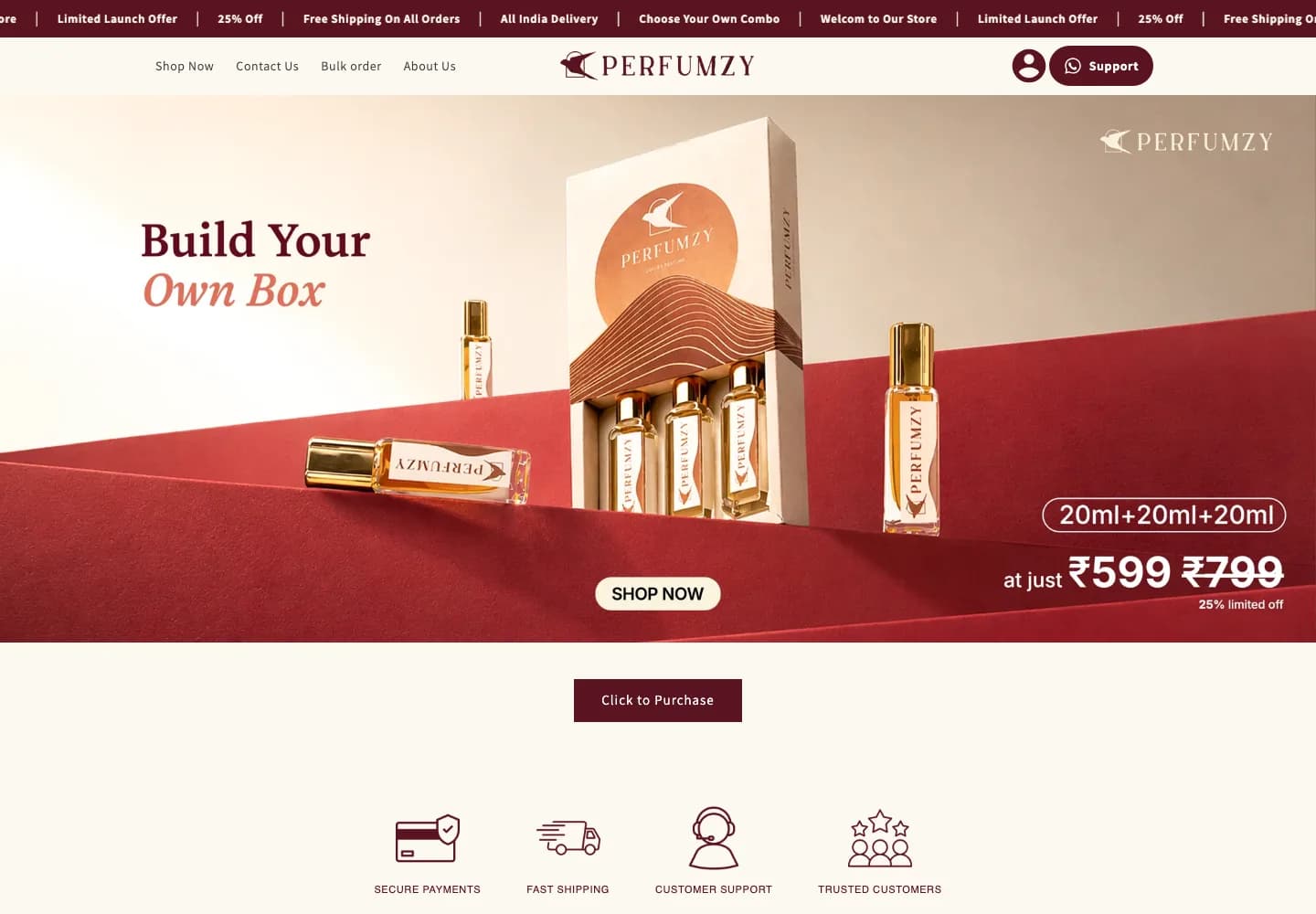
That is why something like the Perfumzy Build Your Own Box case makes sense as custom Shopify work. The core purchase path is not a standard product page. Shoppers need to choose multiple fragrances, see what is in the box, and understand the fixed bundle offer before checkout. That is a custom shopping mechanic, not just a visual preference.
Custom does not mean complicated
Good custom development should usually make the store easier to run, not harder. The theme editor should stay usable. Section names should be clear. Settings should map to real merchant tasks. A store owner should not need to call a developer every time they want to update copy, swap a product, or change an image.
When custom work is the wrong answer
If the store's real problem is unclear copy, weak product information, poor photography, or missing trust signals, custom development will not fix that by itself. It can create a better container for the content, but it cannot replace the content. A custom product page with vague messaging is still a vague product page.
It is also worth avoiding custom code for features that Shopify or a stable app already handles well. Payment methods, core checkout behavior, review collection, and subscriptions are usually better handled by the platform or a mature app unless there is a very specific reason to go custom.
The decision rule I use
Custom development is worth it when it removes real friction, supports a business-specific workflow, or prevents the theme from becoming fragile. It is not worth it just because custom sounds more premium. The best Shopify builds use theme settings, apps, and custom code in the right proportion for the store, not as a point of pride.
If your business is based in Kerala and the requirement goes beyond a standard theme setup, the Shopify development overview for Kerala brands sets this custom work alongside store builds, revamps, performance, and CRO/UX support.
Need a custom Shopify feature built cleanly?
Explore Shopify work like Perfumzy's Build Your Own Box flow, or get in touch if your store needs a custom section, template, or shopping mechanic.
View My Shopify Work →